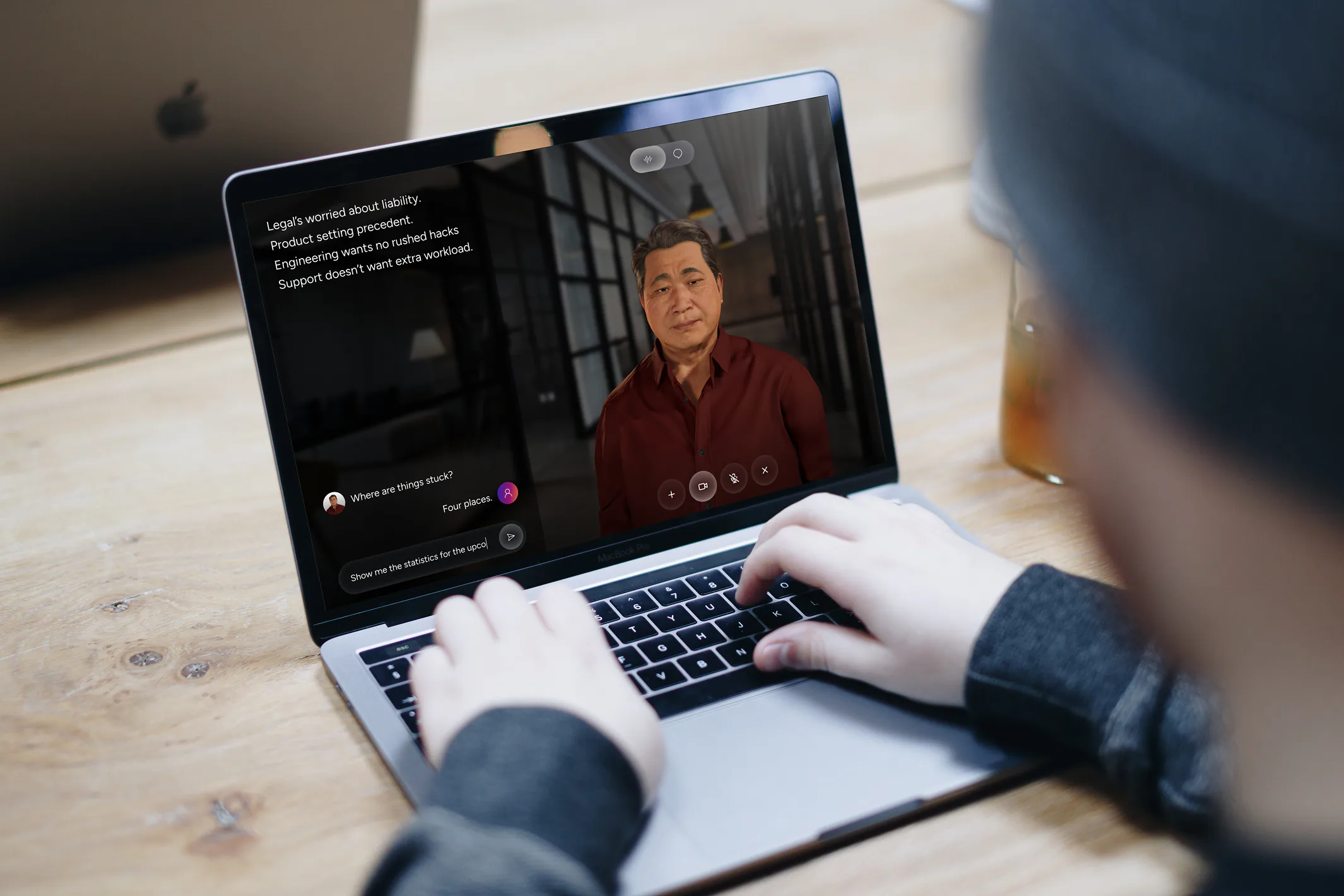

Not a call centre. Hundreds of bankers who serve by phone.
In the bank's own terms these are not call-centre operators. They are bankers who serve remotely, and every service call is a conversation where advice might belong. Whether it does turns on one judgement: recognising the moment to stop fixing a problem and open an investment conversation.
A branch banker walks into a meeting the client came for. A Client Center specialist has the client on the phone about something else entirely. Same coach, opposite starting position.
Under-supported bankers don't fail visibly. The margin just quietly leaves.
Česká spořitelna named this a structural problem, not a training gap. The distinction decided what to buy: a gap closes with a course, a structure needs something that keeps working after the course is over. Four forces were pulling against the bank at once.
Performance below potential
Most bankers never reach the level they could with consistent, systematic support. Clients drift away, or stay with the bank but buy some products from a competitor. Either way the margin leaves.
Turnover resets the clock
High staff turnover means the ramp never ends. Institutional knowledge walks out of the door, and every new joiner starts the learning curve from the bottom.
The pivot nobody teaches
A client rings about a fee, a card, a payment. Somewhere in that call there is either an opening for an investment conversation or there is not, and the specialist has to read which, then change the register without sounding like they are selling. That judgement is in no product manual.
Sales enablement that nobody opens
Existing tools deliver small uplift for heavy deployment and customisation effort, and staff dislike them. Schematic training that rewards memorising set answers leaves no room to actually grow.
Every specialist got their own coach, and kept it.
The bank did not buy a course. Every specialist got their own Empower Agent and kept it: voice-first, in Czech, on the phone they already carry. Nothing is scripted and nothing is memorised. The coaching happens in the three situations where a banker reaches for help.
A task to work through
L&D sets the brief: learn to respond well to client anxiety about market swings tied to a specific global event. The specialist works it with the Empower Agent until the response is theirs, not recited.
The call that starts in ten minutes
Instead of walking over to ask a manager, the specialist describes the situation to their own Empower Agent and gets targeted preparation for that specific conversation, on the spot.
The client who pushes back
When rehearsal is what is needed, the Empower Agent hands the specialist to a role-play simulation: a client of a type they actually meet, who hesitates, objects and changes the subject. The specialist runs the call out loud, as often as they want. Getting it wrong five times costs nothing.

Spoken, not typed. The specialist rehearses the call out loud, exactly as they would hold it.


Every conversation leaves a trace.
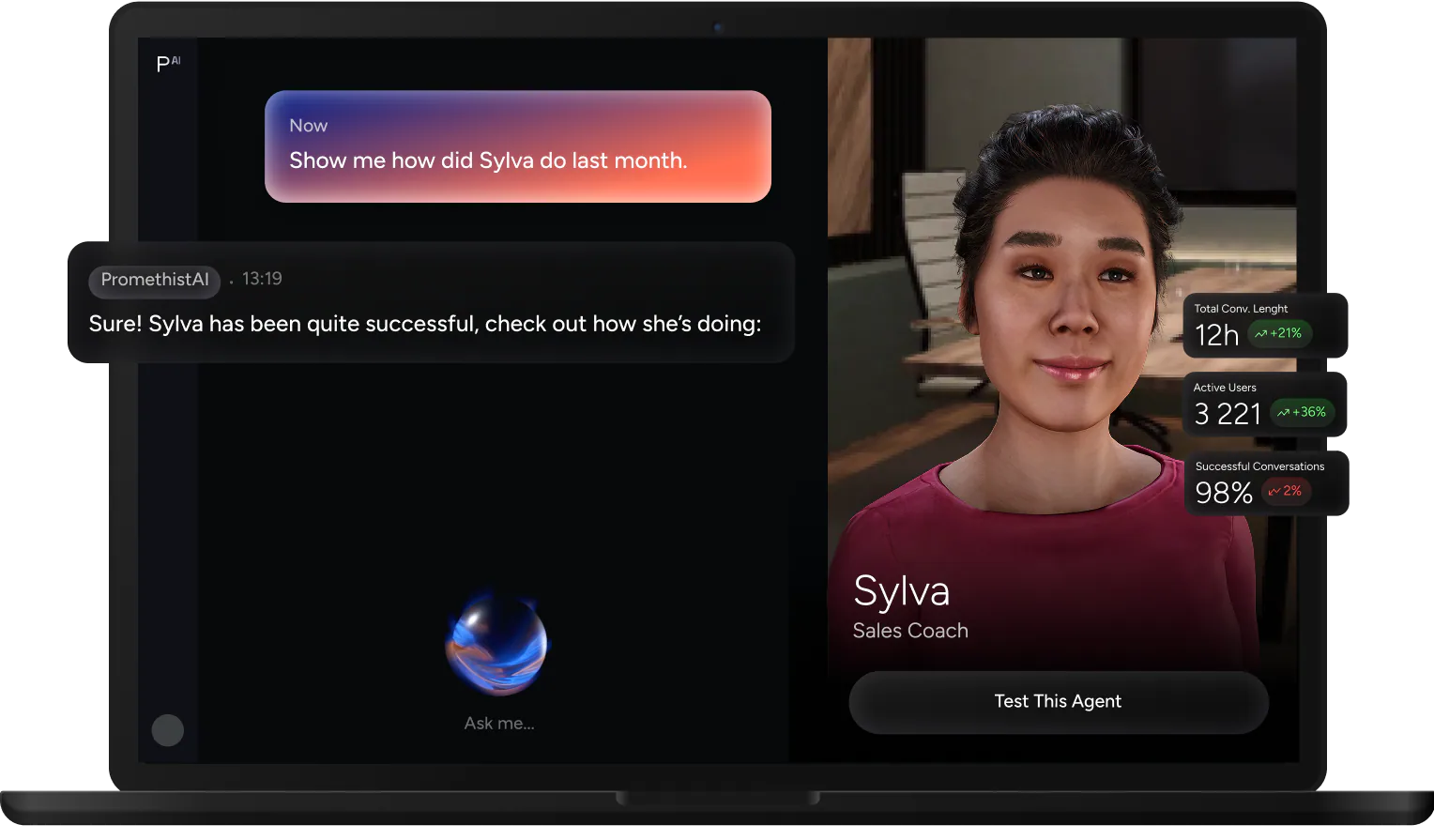
The Empower Agent scores and summarises each session, so the specialist can see what they did well and what to carry into the next call. The same record is what lets the coach get sharper about one person over time, rather than restarting from zero every session.
Four properties that only hold if the coaching is continuous.
Knows each person individually
The coach builds a model of one specialist, not a cohort. The more coaching conversations it holds with them, the better it locates the weaknesses they cannot see and teaches them to work through them.
Targeted training, attachable
Specific topics and skills plug into the same coach: investment conversations, objection handling, a time-boxed campaign. Education and sales enablement stop being separate systems.
Available at the moment of need
Coaching happens in the ten minutes before a call, not in a quarterly workshop. Preparation lands while it still has somewhere to go.
Visible where it matters
The bank tracks conversion and average contract value per cohort, so it can see which training themes move commercial outcomes and which do not.
The benefit is big, and not just that the client says yes to investing. It gives the banker enormous self-confidence and certainty. If you get it wrong five times with the agent, nothing happens. It just teaches you.
Two months on one theme. Conversion more than doubled.
Česká spořitelna ran continuous training on a single question: how to handle investment meetings better. It judged the result on the two metrics it already tracks across every team, conversion and value booked per meeting. On the bank's own reporting, investment meeting conversion rose by up to three times across teams, and the value of newly closed investment contracts rose by half.
One Client Center cohort is charted below, month by month, and month four is the most useful part of it. Trainings fell by a third and conversion fell with them, without dropping back to the starting month. Volume per meeting held. A single cohort cannot separate that from anything else that changed that month, but it is the shape the bank was looking for.
| Period | Conversion |
|---|---|
| Month 1 | 17.5% |
| Month 2 | 35.2% |
| Month 3 | 43.5% |
| Month 4 | 38% |
| Period | Volume per meeting |
|---|---|
| Month 1 | 6 800 Kč |
| Month 2 | 9 950 Kč |
| Month 3 | 10 450 Kč |
| Month 4 | 10 400 Kč |
| Period | Total trainings |
|---|---|
| Month 1 | 0 |
| Month 2 | 205 |
| Month 3 | 293 |
| Month 4 | 193 |
From under a fifth of investment meetings closing to well over two fifths, within this cohort.
Average value booked per investment meeting, against the same cohort's own starting month.
Conversion tells you more conversations closed. This tells you they closed bigger. The specialists were not just converting more often. They were holding more ambitious conversations, after two months on one training theme.
What specialists say is different about their own practice now.
- 87%
- Say the analysis of their mistakes tells them what to do better next time
- 78%
- Got clearer on their own strengths and weak spots
- 70%
- Feel more confident in real client meetings
Fourteen of them, in their own words.
The feedback is real. It usually matches what my team leader tells me after they've listened in on a meeting or a supervision.
Read all 14 in one list
“The feedback is real. It usually matches what my team leader tells me after they've listened in on a meeting or a supervision.”
“It's the best training simulator I've ever had.”
“The benefit is big, and not just that the client says yes to investing. It gives the banker enormous self-confidence and certainty. If you get it wrong five times with the agent, nothing happens. It just teaches you.”
“Instant answers. I finish a sentence and it processes it and replies straight away. That's what lets me hold a flowing conversation, the way it really is.”
“I treat it like a game, I want to beat the client. So I work out what I actually need to say to get there.”
“Before, all we could do was type, and get feedback on the writing. This is far closer to reality, the characters are there, you can see them, and they react.”
“With the old tool, whatever I said to it, the feedback was always positive. I could pat myself on the back and say it went well, but I knew myself that something was missing.”
“It helped me name my weak spot: I don't respond enough to what the client is afraid of. I go straight to explaining the technical side instead of understanding them first.”
“I tell it what kind of client I have and what I'm stuck on, and it suggests the questions to ask so I can find out more. I did that three times for clients I couldn't read at all.”
“When I take the conversation in the wrong direction, the simulated client starts steering me back.”
“It helps me open the conversation up instead of running the same script I'm used to, and it helps me break the amount down so it makes more sense. I'm less afraid to name a bigger number to the client.”
“What I can really do is try different versions of how to solve it. Then I replay it in my head and think: that one, that was the golden middle path.”
“It's motivating and balanced. I come away with observations I can actually use in practice.”
“I'd like it to be a standard, having someone like that on hand to try out an argument or get a tip. Not just for the new joiners, for us too.”
Premier and mass-market are not the same job. The coach knows which it is talking to.
A regulated European bank, a remote-serving unit with its own segments and criteria, an incumbent tool to displace, and commercial metrics as the bar.
In production inside a regulated bank
Not a sandbox or an innovation-lab build. Live in Česká spořitelna, part of Erste Group. The bank has worked with Promethist for three years, starting on the customer side, and the Client Center coach runs inside that programme.
Two very different populations, one platform
The same coaching layer serves branch bankers and remote Client Center specialists, whose work, tooling and conversations have almost nothing in common. The branch network story is a separate case study.
Segment-aware coaching
Premier and mass-market bankers are judged on different criteria and hold different conversations. The Empower Agent distinguishes them rather than averaging everyone into one script.
Voice-first, on the phone they already carry
No new hardware, no desk-only client, no scheduled workshop. Spoken Czech, opened in the ten minutes before a call.
Bankers stopped choosing the incumbent
The bank ran an established sales-enablement tool alongside it. Bankers stopped choosing the incumbent, and said so, unprompted, in the interviews.
Measured on the bank's numbers
Success was judged on conversion and value per meeting, the metrics the bank already tracks across every team, not on course completions or satisfaction alone.
Passing the bank's own review was the entry ticket. The harder half is whether people on the phones all day choose to open it.
Most enablement software clears procurement and then quietly goes unused. So the number the bank watched was not logins in week one. It was what the people who had to use it every day said months later.
The reception, from people who had no obligation to like it.
- 92%
- Rated it positively overall
- 96%
- Feel in control of which skills they choose to develop
- 65%
- Used it weekly or more throughout
Your service calls already have the client on the phone.
The calls are already happening. What was missing was a way for every specialist to get better at the moment service turns into advice, individually, continuously, and without pulling anyone off the phones for a workshop.